

Blog
7 Tips for Choosing Custom Cigar Labels
A cigar label does more than carry a name. It helps a product look consistent, recognizable, and carefully made. Choosing custom cigar labels involves practical decisions about material, size, print quality, and finish. Each choice affects how the label appears on the cigar and how it holds up during handling. Details matter.
Start with the cigar’s dimensions and the packaging conditions. A label that looks balanced on a screen may feel crowded when wrapped around the product. Paper texture, adhesive strength, and color contrast also deserve attention. A printer can confirm which materials suit your design and production process. Ask for a physical proof when possible; small differences in color and scale can be easy to miss in a digital preview.
The seven tips in this guide explore these choices, from defining a clear visual identity to checking legibility and reviewing the final proof. They are intended to help brands and packaging teams make informed decisions, not promise a particular sales result. Keep product details accurate, and confirm that the finished label meets the requirements that apply to your market. A glossy finish may look striking, but it is not automatically the best fit. Sometimes a simpler design communicates more clearly. It is worth reconsidering a favorite idea if it makes essential information harder to read. A careful review can prevent avoidable revisions and produce a label that feels considered, not overworked.
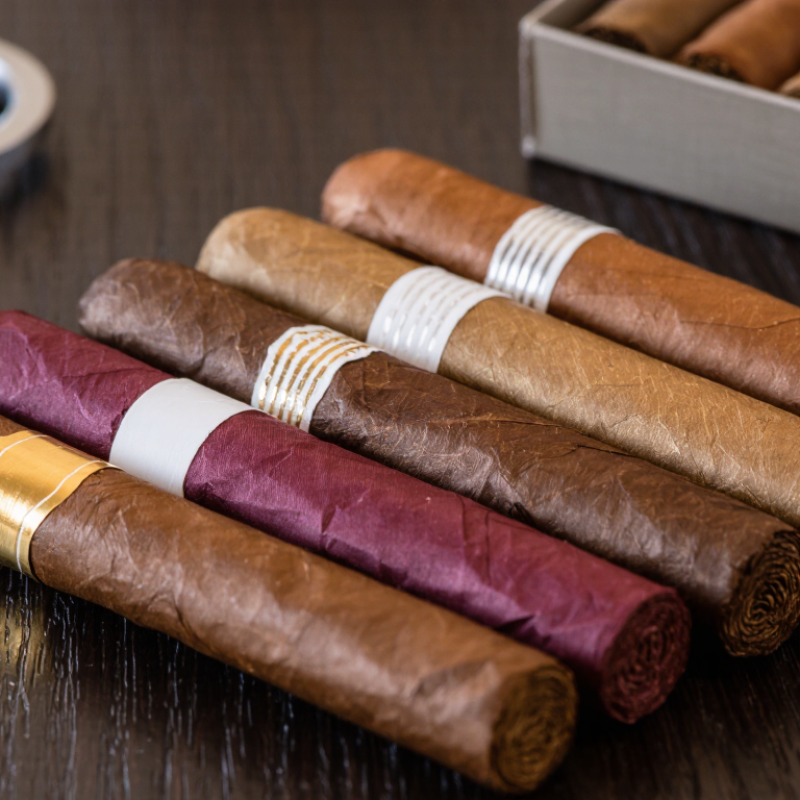
Identify the Purpose and Requirements of the Cigar Label
Decide what the label must do before choosing foil, embossing, or color. Is its main job to identify a blend, explain origin, distinguish sizes, or support batch tracking? Retail buyers may look for blend and format. Collectors may want wrapper details, aging notes, or batch information. Keep each claim factual and verify market-specific labeling requirements with qualified professionals; rules vary by location.
Transparency can shape the information hierarchy. Label Insight’s 2016 Transparency ROI Study, based on 2,000 U.S. consumers, reported that 73% would pay more for products offering complete transparency. That finding is not specific to cigars, but it suggests that clear, useful details can matter. Give essential information readable placement, not tiny type squeezed beside decorative borders. A neat label can still miss the point.
Material choices should serve the label’s purpose, too. Nielsen’s 2015 Global Corporate Sustainability Report found that 66% of surveyed consumers were willing to pay more for products from sustainable brands. This is broad consumer research, not a cigar-specific result. Still, it can prompt practical questions: Will the stock withstand handling? Does the finish obscure small text? Test a printed sample under real lighting. I’d revisit the brief if decoration wins over legibility.
Select Label Materials and Finishes for Cigar Storage Conditions
A cigar label must suit the conditions where the product is stored, not just look sharp on a display. In a humidor, moisture can soften paper, weaken adhesive, and curl exposed edges. Choose a label stock designed to tolerate humidity, and ask the printer for material data rather than relying on appearance alone. A coated or synthetic face may resist damp handling, while a suitable adhesive helps prevent lifting. Test it first.
Finishes also affect durability. Heavy embossing or foil can add texture, but raised details may catch during packing and handling. A restrained protective coating can reduce scuffs from boxes and fingers, though some coatings change the paper’s color or feel. Check samples after exposure to the expected storage range, then inspect the corners and seams. Small defects show up there first. Keep a few samples in a representative humidor for several days, and compare them with labels stored in a dry room. This is not a perfect simulation, but it can reveal curling, fading, or adhesive failure before a full production run. Record the material, finish, and test conditions so future orders can be compared reliably.
| Tip | Storage Condition | Material or Finish to Consider | Practical Selection Notes |
|---|---|---|---|
| 1. Match the label to the storage environment | Cigars are commonly stored around 65–70% relative humidity and 18–21°C (65–70°F). | Moisture-tolerant label stock, such as coated paper or a suitable synthetic film | Ask the label converter to confirm that the face stock, ink, and adhesive are suitable for repeated exposure to humid storage. Test the complete label on the actual box or wrapper. |
| 2. Check adhesive performance in humidity | Humidors and other controlled-humidity storage may expose labels to moist air over extended periods. | Permanent adhesive specified for the packaging surface and intended humidity range | Test for edge lifting, slipping, and residue on the intended substrate. Adhesion depends on both the adhesive and the box surface, so a sample test is important. |
| 3. Choose paper carefully for wood boxes | Wood surfaces can be textured, porous, or affected by changes in humidity. | Durable coated paper with a protective varnish or laminate | Confirm that the label conforms to the surface and that the adhesive bonds well to the specific finish on the box. Avoid assuming that every wood coating behaves the same way. |
| 4. Consider synthetic stock for frequent handling | Labels on boxes that are often moved, opened, or handled may face scuffs and occasional moisture. | Water-resistant synthetic film, such as a label-grade polypropylene or polyester stock | Compare flexibility, print quality, and removability requirements. Make sure the film and adhesive are compatible with the packaging and local disposal or recycling requirements. |
| 5. Select a finish that suits the design and use | Storage conditions may include low light, handling, and contact with nearby packaging. | Matte or gloss varnish, or a protective laminate | Matte finishes can reduce glare; gloss finishes can increase color contrast. A protective coating may improve abrasion resistance, but its performance should be verified with a handling test. |
| 6. Avoid finishes that interfere with readability | Product details may need to remain legible in dim storage or after repeated handling. | Legible print with sufficient contrast; use foil or embossing selectively | Keep essential text clear and readable. Foil and embossing can add visual texture, but they should not obscure required information or make small text difficult to read. |
| 7. Test a finished sample before ordering | Actual performance varies with humidity, temperature, surface coating, and handling. | Production-equivalent sample using the chosen stock, ink, adhesive, and finish | Apply samples to the intended packaging and evaluate them under representative storage and handling conditions. Check adhesion, color, scuffing, and appearance before approving a full run. |
Plan the Layout, Typography, Colors, and Branding
7 Tips for Choosing Custom Cigar Labels
Plan the Layout, Typography, Colors, and Branding
Tip 1
Sketch the label at its actual size before choosing details.
Tip 2
Keep the product name, key information, and required notices in a clear reading order.
Tip 3
Choose a typeface that stays legible on a curved wrapper.
Nielsen’s 2015 Global New Product Innovation Survey reported that 64% of respondents had tried a new product because its packaging caught their eye.
Treat that finding as directional, not a promise of sales.
Small details matter.
Tip 4
Test text against the background in natural and indoor light.
Tip 5
Limit the palette to a few purposeful colors; a deep green beside warm cream can feel quieter than several competing shades.
Check contrast in a printed proof, not only on a bright screen.
Keep it calm.
Metallic inks may shift under different lighting, so verify samples before approving a run.
Tip 6
Repeat a small set of visual cues, such as a border, emblem, or consistent color, to make the design recognizable.
Tip 7
Proof every line, alignment, and mandatory notice against applicable local requirements.
A ruler and a second reader help.
Even careful layouts can feel crowded after printing; leave more breathing room than seems necessary, then review the physical sample before final approval.
Include Accurate Product Details and Required Information
A custom cigar label should make product details easy to verify, not merely attractive on the box. Include the product name, cigar size, quantity per package, and any other details required for that product. Small details matter. Check every number and spelling against approved product records, especially when several sizes share similar names. A small mismatch can confuse buyers or create avoidable reprints. It is easy to trust an old label template, but product information may have changed.
Required disclosures can vary by sales location and may include specific wording, language, placement, or type size. Confirm current requirements with a qualified compliance professional before approving the artwork. Keep required text readable, with enough contrast against the background. A practical prepress check is to compare the proof with the product specification sheet, line by line. Then print a physical sample and inspect it under ordinary indoor lighting. Look for cramped text, unclear numbers, and details hidden by folds or seams. The design may look clear on a bright screen, yet feel crowded on a small package.
Review Proofs, Test Samples, and Confirm Production Quality
A printed proof is a decision tool, not a promise of finished quality. Check the cigar label at actual size, under neutral light, and against the intended wrapper color. Fine gold lines can disappear on textured stock. Small details matter. Review spelling, trim lines, varnish areas, and whether small type remains readable after wrapping. Ask the printer to identify the approved color references and tolerances in writing.
Smithers’ report, The Future of Label Printing to 2028, valued the global label market at about $48.4 billion in 2023 and forecast growth to $67 billion by 2028. That scale makes consistency a practical concern: a sample should represent the chosen material, adhesive, finish, and printing process, not merely a similar substitute. Request several samples. Apply them to the actual packaging surface, then check for lifting edges, wrinkles, scuffing, and color shifts after handling.
Keep one signed proof and one approved physical sample as production references. Ask for documented checks on color, registration, cutting, and roll direction. Compare a fresh production sample with the approved reference before accepting a full run. Do not guess. A digital mock-up may look perfect while the real label feels too glossy or refuses to sit flat. Build in time for one correction; that step is easy to overlook.
7 Tips for Choosing Custom Cigar Labels
Review proofs, test samples, and confirm production quality before approving an order.
The bars count the review items in this seven-point checklist: three for proof review, two for sample testing, and two for production confirmation. Check spelling, artwork, and layout on proofs; compare color and material on samples; then verify the approved setup and inspect the production run. These are checklist counts, not industry survey results.

