

Blog
China Top 10 Tile Laser Cutting Machine Manufacturers
China’s tile manufacturing sector has developed rapidly, supported by advanced automation, competitive engineering, and strong export experience. This guide examines China’s Top 10 Tile Laser Cutting Machine manufacturers through practical buying criteria, not advertising claims. It considers cutting accuracy, laser source quality, machine stability, software functions, after-sales support, and documented production experience.
A Tile Laser Cutting Machine should produce clean edges on porcelain, ceramic, marble, and other hard surfaces. However, performance depends on more than laser power. Lens quality, cooling control, table design, dust extraction, and operator training also influence results. Small differences matter.
Dr. Stefan Kaierle, a respected laser-processing researcher, has stated, “Laser processing is not only about power; it is about putting energy precisely where it is needed.” This principle remains useful when comparing Chinese manufacturers. A powerful machine may still create chipping, heat marks, or inconsistent kerfs without accurate motion control.
The companies discussed here are assessed using measurable and practical evidence. This includes factory capability, machine configuration, cutting samples, certification records, customer support, and long-term maintenance feedback. Where public information is limited, that limitation deserves attention. Rankings can change.
Buyers should request test cuts using their own tile thickness, glaze, texture, and design pattern. They should also inspect beam alignment, repeatability, spare-parts access, and software compatibility before ordering. A low purchase price can become expensive when downtime increases.
This overview is not a promise of perfect results. It is a careful starting point for identifying reliable suppliers, comparing real specifications, and choosing equipment suited to production conditions.
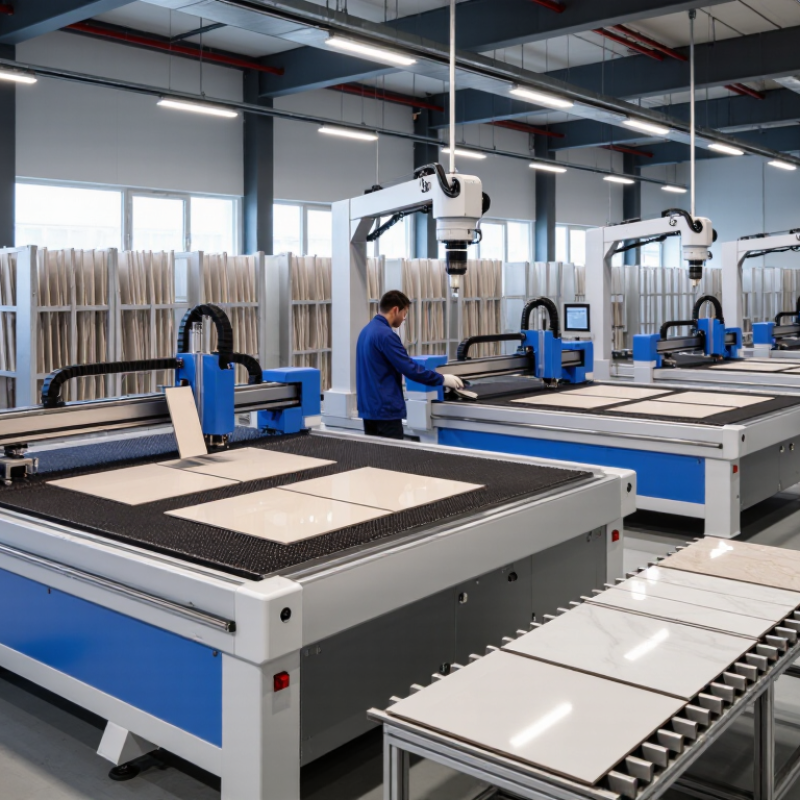
Tile Laser Cutting Machines: Market Scope and China’s Top 10 Ranking Criteria
China Top 10 Tile Laser Cutting Machine Manufacturers
Tile laser cutting machines serve ceramic, porcelain, stone-look, and engineered surfaces. Their market scope follows broader industrial laser adoption, not tile demand alone. MarketsandMarkets estimates the global laser cutting machine market will grow from about USD 6.5 billion in 2023 to USD 10.1 billion by 2028. Grand View Research also reports strong growth through 2030, driven by automation and tighter cutting tolerances.
China’s top ten ranking should therefore measure practical performance. The proposed model assigns 25% to cutting accuracy and edge quality, especially on glazed porcelain. Another 20% covers throughput, including stable operation at repeated 45-degree cuts. Machine rigidity, laser source compatibility, dust extraction, software control, and energy use receive further weight.
Service response and spare-part availability matter greatly. A precise machine is useless during a long production stoppage.
Real testing remains essential. Buyers should inspect a 600-by-1200-millimeter tile after cutting, checking chips, heat marks, and corner consistency. Independent laboratory data should support claims about accuracy and power consumption. ISO 230-style measurement practices can improve comparison, although suppliers may report results differently. That is a weakness.
The final ranking should combine audited specifications, factory experience, customer references, warranty terms, and five-year ownership cost. A cheaper machine may require more maintenance. A polished catalogue proves little. Our scoring should include production samples, technician interviews, and transparent failure records, even when the results look imperfect.
CO₂ and Fiber Lasers: 0.1 mm Accuracy, 80–150 W Power, and Key Applications
China’s top 10 tile laser cutting machine manufacturers are often compared by accuracy, laser stability, and practical cutting results. For tile processing, CO₂ and fiber systems serve different technical needs. CO₂ lasers commonly work well with ceramic, porcelain, glass, and other nonmetallic surfaces. Fiber lasers are more suitable for metal-backed tiles, decorative inserts, and mixed-material components.
A 0.1 mm accuracy claim sounds impressive, but it requires careful testing. Operators should check beam alignment, gantry movement, lens cleanliness, and thermal expansion during a full production shift. Even a small vibration can create chipped corners or uneven grout lines. An 80–150 W CO₂ source can cut detailed patterns, drainage openings, wall panels, and custom borders. Cutting speed depends on tile density, glaze thickness, and cooling conditions. Power alone does not guarantee a clean edge.
Fiber machines may deliver fine detail on stainless steel trims, aluminum inlays, and thin metal accessories. Practical buyers should request sample cuts using their own tile batches, not showroom material. That matters. Ask for measured tolerance reports, maintenance records, operator training, and independent equipment tests. Some specifications remain optimistic. I have seen machines meet 0.1 mm accuracy briefly, then lose consistency after extended operation. A reliable manufacturer explains these limits clearly and provides calibration procedures, spare-part access, and documented safety controls.
Tile Laser Cutting Machines: CO₂ and Fiber Laser Applications
Representative power levels within the 80–150 W range for common tile processing tasks. With suitable optics, motion control, and material preparation, positioning accuracy can reach approximately 0.1 mm.
CO₂ lasers are commonly used for ceramic, porcelain, glass, and other non-metallic surfaces, while fiber lasers are generally selected for metal tile cutting, marking, and engraving. Actual performance varies with material thickness, surface coating, lens configuration, and machine calibration.
China’s Top 10 Manufacturers: Product Range, Certifications, and Export Reach
China’s top ten tile laser cutting machine manufacturers show a broad product range. Their catalogues commonly include CO2 laser cutters, CNC positioning tables, ceramic engraving systems, dust extraction units, and automated loading options. Some suppliers also offer customized worktables for porcelain slabs and small-format decorative tiles. Fortune Business Insights estimates the global laser cutting machine market will grow from about USD 5.4 billion in 2023 to nearly USD 9.9 billion by 2032. This growth supports wider investment in precise, digitally controlled equipment.
Certification claims require careful checking. ISO 9001 can indicate controlled quality processes, while CE documentation supports access to European markets. However, a logo alone proves little. Buyers should verify certificate numbers, issuing bodies, machine scope, and validity dates. Intertek and SGS inspection reports may add useful third-party evidence, especially for factory audits and shipment checks. Export experience varies across these manufacturers. Established suppliers often serve customers in Southeast Asia, the Middle East, Europe, and South America, with multilingual manuals and remote commissioning. Export volume is not the same as service quality. Response time, spare-part availability, training, and documented cutting trials matter more during production. A ranking is never perfectly neutral. Product data may also change between catalogues and delivered machines. Requesting sample cuts on the buyer’s actual tile thickness remains the most reliable comparison.
China Top 10 Tile Laser Cutting Machine Manufacturers - China’s Top 10 Manufacturers: Product Range, Certifications, and Export Reach
| Rank | Anonymized Manufacturer Profile | Primary Product Range | Typical Working Area | Typical Laser Configuration | Common Certifications | Typical Export Reach |
|---|---|---|---|---|---|---|
| 1 | Profile A | Ceramic tile, porcelain slab, marble, granite, and engineered-stone cutting systems | Approx. 1,300 × 2,500 mm to 2,000 × 4,000 mm | Fiber laser, commonly 1,500–3,000 W | CE; ISO 9001 commonly available | Asia, Middle East, Europe, Africa, and South America |
| 2 | Profile B | Tile edge trimming, straight cutting, beveling, drilling, and profiling equipment | Approx. 1,200 × 2,400 mm to 1,800 × 3,600 mm | Fiber laser, commonly 2,000–6,000 W | CE; ISO 9001; electrical conformity documentation | Southeast Asia, the Middle East, Africa, and Latin America |
| 3 | Profile C | Compact laser cutters for ceramic tiles, decorative panels, and countertop components | Approx. 1,300 × 2,500 mm | Fiber laser, commonly 1,000–2,000 W | CE; ISO 9001 may be available by production site | Domestic China sales plus Asia, Africa, and the Middle East |
| 4 | Profile D | Large-format porcelain slab and natural-stone laser cutting lines | Approx. 1,600 × 3,200 mm to 2,000 × 6,000 mm | Fiber laser, commonly 3,000–12,000 W | CE; ISO 9001; machine-safety documentation | Europe, North America, Australia, the Middle East, and Asia |
| 5 | Profile E | CNC laser cutting machines for tiles, ceramic mosaics, and stone inlays | Approx. 1,300 × 2,500 mm to 1,500 × 3,000 mm | Fiber laser, commonly 1,500–3,000 W | CE; ISO 9001 commonly referenced | Asia, Africa, the Middle East, and selected European markets |
| 6 | Profile F | Automated tile processing cells with loading, cutting, and unloading functions | Approx. 1,500 × 3,000 mm to 2,000 × 4,000 mm | Fiber laser, commonly 3,000–6,000 W | CE; ISO 9001; conformity assessment available for export orders | Europe, North America, Southeast Asia, and the Gulf region |
| 7 | Profile G | Entry-level and mid-range laser systems for tile workshops and fabricators | Approx. 1,300 × 2,500 mm to 1,500 × 3,000 mm | Fiber laser, commonly 1,000–2,000 W | CE; factory quality-control records often provided | China, Central Asia, Africa, and Southeast Asia |
| 8 | Profile H | High-speed cutting and engraving systems for ceramic surfaces and decorative tiles | Approx. 1,300 × 2,500 mm to 1,800 × 3,600 mm | Fiber laser, commonly 1,500–4,000 W | CE; ISO 9001 may be available depending on the factory | Middle East, Africa, South America, and Southeast Asia |
| 9 | Profile I | Customized laser cutting and stone-processing solutions for project contractors | Approx. 1,500 × 3,000 mm to 2,000 × 6,000 mm | Fiber laser, commonly 3,000–12,000 W | CE; ISO 9001; project-specific technical files | Europe, North America, Australia, and the Middle East |
| 10 | Profile J | Affordable CNC tile cutters with optional drilling, beveling, and edge-finishing modules | Approx. 1,200 × 2,400 mm to 1,500 × 3,000 mm | Fiber laser, commonly 1,000–3,000 W | CE; manufacturer quality documentation | Asia, Africa, Latin America, and selected Middle Eastern markets |
Note: Specifications, certifications, and export coverage vary by model, production site, and destination market. Buyers should verify current certificates, machine configurations, and shipment records directly before purchase.
Performance Benchmark: 1200–1600 mm Beds, 30 m/min Speed, and Kerf Width
A practical benchmark starts with the working bed. For tile processors, 1200–1600 mm beds suit common wall and floor tile formats, while leaving room for clamps and edge clearance. A 30 m/min positioning speed sounds impressive, but it is not the cutting speed. Ceramic materials often require slower movement, staged power, and careful heat control. The difference is visible at the corner.
Kerf width deserves equal attention. In production trials, a focused laser may create a narrow cut below 0.5 mm, but tile glaze, thickness, and surface texture change the result. Wider kerfs can reduce dimensional accuracy and increase chipping. ASTM C499 identifies dimensional testing methods for ceramic tile, while ISO 11145 defines key laser-processing terms. These standards support consistent measurement, not automatic quality.
MarketsandMarkets reported continued growth in the global laser cutting machine market through the current decade, driven by automation and higher production flexibility. That growth should not replace physical testing. Operators should record actual speed, kerf width, edge temperature, dust levels, and breakage rates across several tile batches. A catalog figure can mislead. I have seen a fast setup produce slower usable output after rework. The 1200–1600 mm bed range is practical, yet oversized panels may still need repositioning. Performance claims need evidence.
Purchasing Standards: ROI, CE/ISO 9001 Compliance, Warranty, and After-Sales Service
China Top 10 Tile Laser Cutting Machine Manufacturers
When comparing tile laser cutting machine manufacturers in China, ROI should guide the decision. Calculate output per shift, labor savings, energy use, maintenance costs, and expected downtime. A lower purchase price may hide expensive lenses, weak extraction systems, or slow technical support. Ask for cutting samples using your tile thickness, surface finish, and required edge quality. Real tests reveal more than polished brochures.
Compliance requires careful checking. CE marking should match the machine configuration and applicable European requirements, not merely appear on a sales page. An ISO 9001 certificate can indicate controlled processes, but it does not guarantee cutting performance. Request current certificates, serial-number records, electrical safety documents, and a clear inspection report. I would also verify whether the certificate covers the actual manufacturing site. Small details matter.
Tips: Put every promise in the contract. Specify laser power, positioning accuracy, delivery time, training, spare parts, and response times. Check whether the warranty covers the laser source, control system, and major optics. Ask how remote diagnosis works and where replacement parts are stored. A strong after-sales plan includes installation guidance, operator training, preventive maintenance, and documented escalation. Still, no supplier is perfect. Review your own production risks honestly before signing.

