

Blog
What Are the Best No Tear Drawstring Garbage Bags?
Choosing the right kitchen bag sounds simple until a loaded liner splits beside your shoes. A reliable No Tear Drawstring Garbage Bag should handle daily waste without stretching, leaking, or losing its closure. Yet “no tear” is not a magic promise. Even thick plastic can fail when sharp packaging, wet food, or excessive weight is involved.
This guide examines the practical details that matter at home. We consider material thickness, seam strength, drawstring design, fit, odor control, and real carrying comfort. A bag may feel strong in the bin but weaken when lifted from a crowded container. Small differences matter. A reinforced rim can prevent sudden tearing. A smooth drawstring can reduce hand strain during removal. Good sizing also leaves enough room to tie the bag securely.
Performance depends on the waste.
That point deserves honesty. No single product suits every household, office, or cleaning routine. Our recommendations focus on observable features, realistic use, and dependable manufacturer information rather than bold packaging claims. Where possible, compare capacity ratings with actual bin dimensions. A 13-gallon label may not fit every tall kitchen can perfectly.
The best choice balances strength, flexibility, leak resistance, and price. It should also make disposal cleaner and less stressful. A careful buyer will inspect the seams, test the closure, and avoid overfilling. Those habits cannot repair a weak bag, but they can reveal whether the product deserves your trust.
What Makes a Drawstring Garbage Bag Resistant to Tearing
What Are the Best No Tear Drawstring Garbage Bags?
A no-tear bag is not magic; it balances material strength, stretch, and construction. In my experience, bags fail when thin film meets sharp edges, uneven weight, or a tightly pulled closure. Durable options usually use carefully blended plastic resin and film that stretches before breaking. Thickness matters, but thicker does not always mean stronger. Poorly made thick film can still split along weak points.
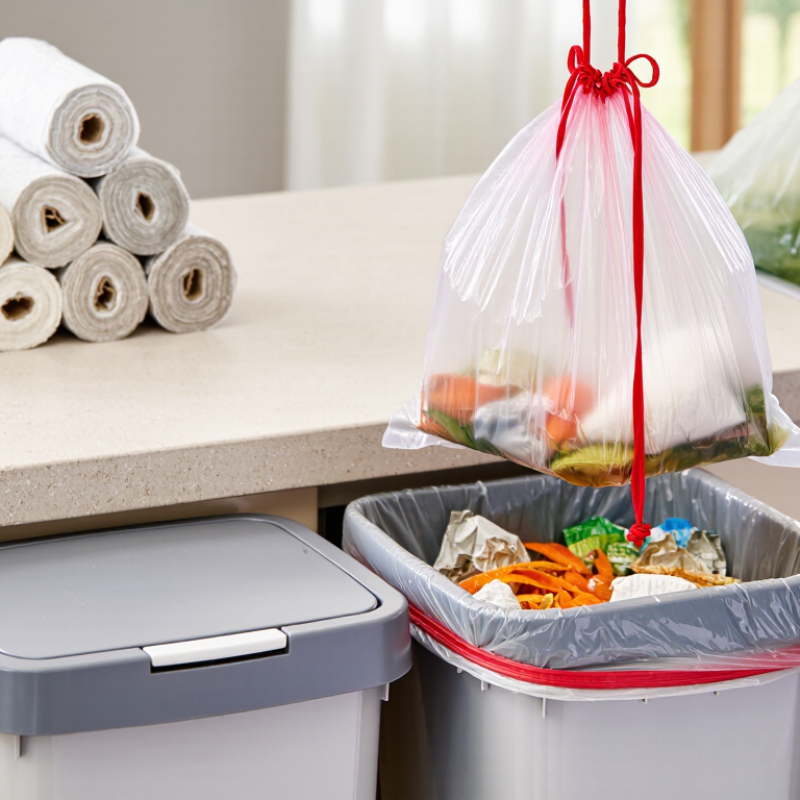
Look closely at the drawstring area. The string should sit inside a reinforced channel, not cut directly into the bag film. Strong side seals also matter because a small seam defect can become a long tear during lifting. I test a bag with empty boxes, food packaging, and damp waste, then lift it by the tied closure. It should flex without whitening, sudden splitting, or stretched holes. Keep sharp objects away from the film.
Real use is less predictable. A bag that handles soft household waste may fail with broken plastic, bones, or rough metal edges. That limitation deserves attention. I once overfilled a heavy-duty bag and found a tiny split near the bottom seam. The material was strong; my judgment was not. Check the stated capacity, leave headspace for tying, and avoid dragging a loaded bag across concrete. Small handling choices often protect the film better than advertising claims.
What Are the Best No Tear Drawstring Garbage Bags? - What Makes a Drawstring Garbage Bag Resistant to Tearing
| Bag Construction | Typical Thickness | Key Tear-Resistance Feature | Typical Strength Profile | Best Use | What to Check Before Buying |
|---|---|---|---|---|---|
| Multi-layer LLDPE film | 0.8–1.5 mil (20–38 microns) | Linear low-density polyethylene provides high elongation and allows the film to stretch around sharp or irregular waste. | Usually offers better puncture and tear resistance than a thin single-layer film at a similar thickness. | Kitchen waste, bathroom waste, office waste, and mixed household rubbish. | Look for multi-layer construction, even film thickness, and a bottom seal without thin corners. |
| Thick LLDPE heavy-duty bag | 1.5–3.0 mil (38–76 microns) | Greater film mass gives the bag more material to absorb punctures and resist propagation after a small tear begins. | High overall load capacity and strong resistance to heavy, wet, or irregular contents. | Garage, workshop, yard cleanup, renovation debris, and heavy household waste. | Check the rated capacity, bottom-seal quality, and whether the drawstring channel is reinforced. |
| Co-extruded multi-layer film | Commonly 1.0–2.5 mil (25–64 microns) | Different polymer layers can be engineered for a balance of flexibility, puncture resistance, and sealing performance. | Consistent performance when the layers are properly bonded and the film is evenly produced. | General-purpose waste where both flexibility and strength are important. | Check for uniform seams, no visible delamination, and clear thickness information. |
| High-density polyethylene film | 0.35–0.8 mil (9–20 microns) | High-density polyethylene can provide good tensile strength at low thickness, but it is less flexible than LLDPE. | Works well for lighter, dry waste; sharp objects can initiate a tear more easily if the film is too thin. | Light office waste, paper, tissues, and dry bathroom waste. | Choose a thicker grade for sharp or bulky contents and avoid overfilling the bag. |
| Reinforced drawstring channel | Depends on the film thickness | A wider, well-sealed channel distributes pulling force instead of concentrating stress at one narrow point. | Reduces ripping around the opening during lifting, tying, and removal from the bin. | Any application where the bag is frequently lifted by its drawstrings. | Inspect the channel for smooth stitching or heat seals, sufficient material around the holes, and secure string attachment. |
| Star-sealed bottom | Available across several thicknesses | Folded film converges at the bottom without a flat seam that can create a single weak line. | Helps distribute weight and reduces the risk of leakage or seam failure under uneven loads. | Wet waste, food waste, pet litter, and containers with uneven shapes. | Check that the bottom seal is centered, continuous, and free from pinholes or incomplete fusion. |
| Stretchable low-density polyethylene blend | Usually 1.0–2.0 mil (25–51 microns) | Flexible polyethylene can deform around contents rather than splitting immediately when stretched. | Good flexibility and impact tolerance, though performance depends on the exact resin blend and manufacturing quality. | Mixed household waste and bins containing bulky but relatively light items. | Look for a balanced combination of stretch, thickness, and a strong bottom seal rather than thickness alone. |
Practical selection rule: For the lowest risk of tearing, choose a multi-layer LLDPE or co-extruded bag with sufficient thickness, a reinforced drawstring channel, and a star-sealed bottom. Thickness values are typical industry ranges; actual performance varies with resin formulation, manufacturing quality, load type, and storage conditions.